High-growth startups are messy, exhilarating, and full of opportunities to learn on the fly. Few people know this better than Max Pazevic, Growth Operations Lead at Omni, who…
High-growth startups are messy, exhilarating, and full of opportunities to learn on the fly. Few people know this better than Max Pazevic, Growth Operations Lead at Omni, who has spent his career building and fixing RevOps infrastructure at fast-moving companies like Apartment List and Rippling.
In this episode of RevOps Bites, Kathryn sat down with Max to talk about why he thrives in high-growth environments, how he balances speed with scalability, and why breaking things might just be the best way to learn RevOps.
Max didn’t enter RevOps through a traditional path. His start was in data operations, where he quickly automated himself out of a job.
"One of my managers noticed I was only working two hours a day because I’d automated the rest. They said, why not apply those automations to Salesforce? Ten years later, I’ve been doing RevOps ever since."
That pivot set the tone for his career: finding leverage, solving problems with automation, and learning by doing. Over time, he’s worn nearly every hat in the GTM stack from pre-sales to post-sales, from revenue accounting to systems design.
For Max, the draw of startups is simple: speed.
In contrast, mature companies often lock operators into editing existing systems rather than designing new ones. Startups give RevOps professionals hands-on ownership from day one.
One of the biggest challenges in high-growth RevOps is balancing quick fixes with scalable solutions. Max admits he often errs on the side of speed:
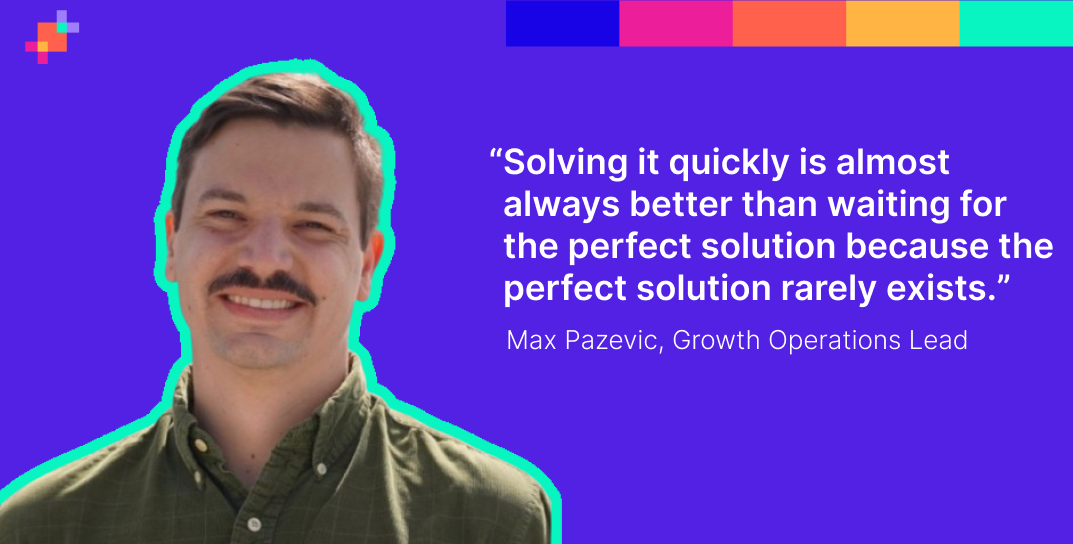
The key is documentation. Even if the first version is scrappy, writing down what was built allows you to revisit and improve later. And for Max, AI has become a game-changer in lowering the barrier to documentation:
Max is the first to admit that most of us are still in the "experimentation phase" with AI. Aside from meeting recorder Fathom (which he swears by), he doesn’t see clear best practices yet.
But what matters most, he argues, is curiosity:
This curiosity-driven approach helps him keep pace with the ever-expanding GTM tech stack. What he describes as "tool proliferation" driven by micro-use cases powered by AI.
With so many specialized tools, Max sees the rise of a new in-between role:
Instead, this "GTM systems person" (sometimes called a GTM engineer) sits in the middle, managing integrations, orchestrating micro-systems, and ensuring the tech stack actually drives revenue.
It’s a shift that reflects the growing complexity of RevOps—and one that high-growth companies especially need to plan for.
For those considering a career in RevOps, Max’s advice is refreshingly blunt:
"Go break something. Push a flow live in Salesforce. Try a tool. Ask the uncomfortable questions. Someone will notice, and that’s how you learn."
Other takeaways from his journey:
Max’s story is a reminder that RevOps isn’t about perfection—it’s about progress. In high-growth companies, something will always be broken, but that’s also where the most growth (both personal and organizational) happens.
👉 Watch our full RevOps Bites episode of with Max Pazevic

Candybox Team
RevOps, Salesforce & HubSpot experts
Candybox designs and runs the Salesforce, HubSpot and AI systems behind fast-growing B2B SaaS companies.








Straight answers to what B2B SaaS teams ask us most. Don't see yours? Just ask us.