Thinking about switching CRMs? This guide helps B2B SaaS leaders evaluate if, when, and how to migrate their CRM - without disrupting revenue or business operations.
Your CRM is supposed to be one of your business's greatest assets. So why does it often feel like an albatross around your neck?
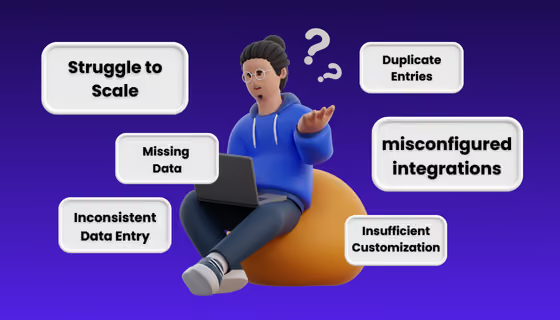
After seeing dozens of B2B SaaS companies grapple with this question, we noticed consistent warning signs that something is amiss:
But will moving to a new CRM solve the issue?
We’ve encountered companies who’ve spent 6-12 months and $200K+ migrating to a new CRM, only to recreate the same fundamental problems. That’s because many "CRM problems" are not platform issues but rather configuration, resource, or data quality issues.
Written for growth-stage B2B SaaS companies (Series A-D) evaluating if their current CRM can effectively support their next phase of growth, this guide will help you to:
Evaluating the three following areas will give you a clearer picture of to what degree your CRM serves as an asset to your business - or to what extent it is holding you back from growth.
If you recognized many of the indicators above in your current CRM, it is possible that migration to a more mature CRM may be a good move for your business.
At the same time, there are myriad factors why CRM issues may crop up. Here are our five reasons why a company might be experiencing issues with their CRM that can potentially be solved without migrating to a new platform:
If your current CRM was set up by someone without extensive experience in CRM architecture, you might be experiencing the impact of non-optimal architectural decisions. Without an experienced internal team or external consultants to manage the platform, your CRM may struggle to scale effectively. As a result, revenue leaders may resort to building their own solutions and reports, often with subpar outcomes.
An out-of-the-box CRM setup rarely aligns perfectly with a company's unique business processes. Customizations such as tailored fields, sales and marketing stages, workflows, and integration will benecessary to reflect your business operations accurately. Investing in these adjustments can enhance usability and ensure the CRM supports your team's needs.
Duplicate entries, outdated information, and missing data can significantly diminish CRM effectiveness, creating the false impression that the system is not suitable. Conducting a data audit and implementing regular maintenance practices - such as deduplication, standardization, and validation rules - can help keep information accurate and actionable. This approach also clarifies whether issues stem from CRM compatibility or inadequate data management practices.
Employees who do not fully understand how to use the CRM often report a poor experience, leading to inconsistent data entry and underutilization of the platform. Investing in comprehensive onboarding and ongoing training can improve user adoption, enhance the overall experience, and maximize the CRM’s potential.
Technical debt can accumulate due to poor initial implementation, misconfigured integrations, inadequate data hygiene practices, or customizations by inexperienced users. Over time, this leads to a CRM that feels slow, cumbersome, and poorly adapted to business needs. Engaging an experienced consultant to review and optimize sources of technical debt - such as custom code, workflows, and integrations - can help streamline the system without requiring a complete platform migration.
If you determine that migration is the right path for your business, here's what you can generally expect:
Note: Timelines vary significantly based on system complexity, data volume, and team resources. We have migrated CRMs in as little a one month for very lean set-ups, or six months for more mature organizations with greater complexity.
If you're facing any of these challenges, it's worth discussing your situation with our team. After helping 70+ B2B tech companies evaluate and improve their GTM tech stacks, we've learned that the decision isn't always straightforward - sometimes a migration isn't the answer, or at least not yet.
We can help you assess your specific situation and determine the best path forward based on:
Book a Migration Clarity Call to:

Candybox Team
RevOps, Salesforce & HubSpot experts
Candybox designs and runs the Salesforce, HubSpot and AI systems behind fast-growing B2B SaaS companies.









Straight answers to what B2B SaaS teams ask us most. Don't see yours? Just ask us.