6
months
to merge Bananatag into Staffbase
for a project that realistically takes a year
5
teams aligned across both companies
0
major bugs after the migration
01
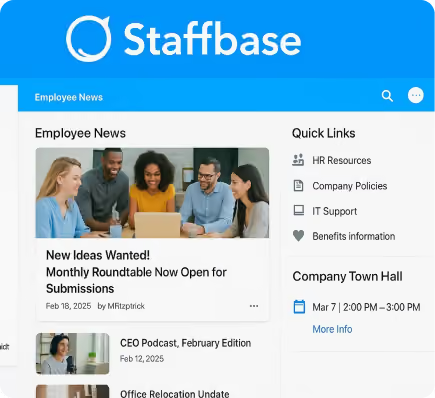
Staffbase brings a mobile-first approach to employee communication and is trusted by over 1000 enterprises worldwide. Candybox and Staffbase have worked together since 2019.
As part of its US expansion, Staffbase acquired Bananatag, a larger and more complex acquisition than before, with an aggressive migration timeline.
02
The scope was very broad: all of Bananatag’s systems and processes had to be analyzed, and nobody had a bird’s eye view of its tech stack and data model. The Business Systems team already had many projects in flight, and around 5 teams with 2-3 stakeholders each were involved on both sides.
We had only six months for something that realistically should take a year.
Staffbase outsourced all discovery and technical implementation to Candybox, along with many of the project management duties.
03
Claudio Cocivera, Senior Manager of Business Systems & Processes, acted as technical architect and advisor, while Candybox took the roles of external project manager and technical architect. The project ran in five stages: discovery, design, build, release and enablement.
Discovery and design
Both companies’ processes understood and unified going forward.
Build and testing
The technical implementation built out and tested.
Data migration guide
A step by step guide, based on a sandbox test migration, so anyone could map data files.
Release and enablement
Data imported, work moved to production and users trained for rollout.
04
On time
The migration happened within the expected timeline.
No major bugs
A clean release across both businesses.
Other projects kept moving
The Business Systems team could still progress other initiatives.
Less mental load
Candybox ran meetings and initiatives independently.
Processes that make sense
Built with minimal input from the Staffbase and Bananatag teams.
5
teams aligned across both companies
We accomplished everything that we planned to and the project was a great success.
05
Staffbase wants to keep improving its processes and make the improvements that were postponed. With strong growth expected, Staffbase plans to engage Candybox to make sure its processes are as scalable as possible.
There has never been a problem the team was not able to solve.









Straight answers to what B2B SaaS teams ask us most. Don't see yours? Just ask us.